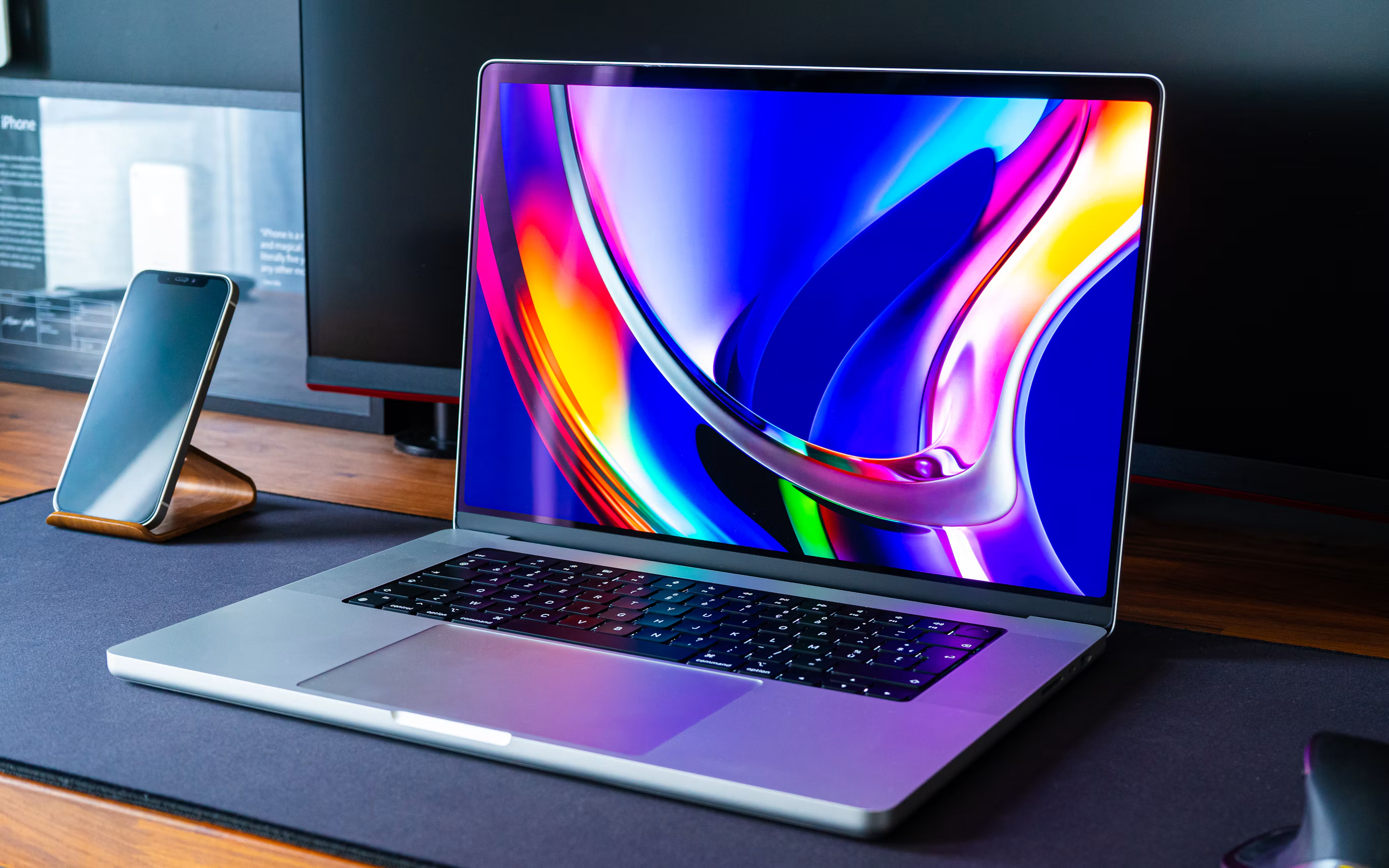
Apple's overhauled touchscreen MacBook Pro, expected to make its debut as soon as this month, could be 'significantly lighter', according to a new Bloomberg report.
In his Power On newsletter, Mark Gurman says that Apple's next generation of MacBook Pros could be a lot lighter, which would help improve the portability of Apple's high-end laptop.
But there is one other major difference, I’m told: The new MacBook Pros are lighter — significantly lighter. Apple has reengineered the machine’s interior, miniaturizing parts and rearranging components to make the computer much easier to carry.
This would be a noticeable improvement to the device, which currently weighs from 1.55kg, but can get up to 2.15kg on the M5 Max 16-inch model.
This is a big difference from the much more lightweight MacBook Air, which weighs as little as 1.23kg. Even the larger 15-inch model weighs just 1.51kg, making it lighter than any MacBook Pro model.
Gurman already reports that the lighter weight will be achieved by miniaturising internal components, but the new OLED display could also help reduce the weight.
OLED panels are often thinner than other display types, such as LCD which is current found in the MacBook Pro. By switching to an OLED panel, which the device is reported to do, Apple could potentially make the new MacBook thinner helping reduce the bulkiness of the device.
As the MacBook Pro uses powerful chips and has fans, I wouldn't expect it to become thinner and lighter than the MacBook Air, but it could come closer than ever to that form factor.
We saw something similar happen when Apple transitioned to OLED displays on its iPad Pro line in May 2024.
Apple's first OLED iPad Pro, with the M4 chip, was 22 grams lighter than its predecessor, and 0.6mm thinner. Whilst these numbers themselves don't seem impressive, any weight or size reduction in a device you hold is a welcome improvement.
What else do we know about the touchscreen MacBook Pro?
The next-generation MacBook Pro is set to be the biggest change to the external appearance of the laptop since it's Apple Silicon redesign in 2021, when Apple reintroduced ports to the device and made the device bulkier. Here's what we're expecting:
- Move from mini-LED to OLED
- Lighter
- Potentially thinner
- M6, M5 Pro and M5 Max
- Touchscreen
- New external design
- Notch replaced by Dynamic Island? This remains unclear
Why has Apple not made a touchscreen Mac before?
Steve Jobs famously declared touchscreen laptops were ”ergonomically terrible” on stage at an October 2010 keynote. His stance on touch input laptops has helped define the separation between Mac and iPad with one designed for touch-based interaction and the other built for keyboard and mouse.
However, this philosophy was challenged during the Tim Cook era, with the introduction of the iPad Pro line, Magic Keyboard for iPad and recent advances in the category including macOS style multitasking on iPadOS and the use of Apple Silicon chips that were designed for Mac.
In addition to this long-standing philosophy, Apple has traditionally maintained a more limited product lineup compared to its competitors, focusing on the needs of mainstream consumers rather than releasing experimental devices.
As a result, the company has often been later to emerging product categories including foldable phones, smart rings and touch screen laptops. This approach has started to shift in recent years with the introduction of the Apple Vision Pro in 2024 and the launch of iPhone Duo in 2026.
Final Thoughts
The upcoming MacBook Pro is shaping up to be a major refresh, with a new hardware design that could significantly reduce the weight of the device. Additionally, the touchscreen will be one of the biggest changes to this product category in a long time, bringing touch input to the Mac for the first time.